
Explanation 4 · Final Consonants
HANGUL, The Cosmic Philosophy · p.197 / 428
On the other hand, letters representing clear sounds ( plain
sounds), aspirated sounds ( strong sounds), and tense
sounds ( reinforced sounds) are pronounced with greater
force. Thus, when used as final sounds, they are most
appropriate for checked tones.
As a result, the six letters ㆁ ㄴ ㅁ ㅇ ㄹ ㅿ ( 인 임 잉 일
)(iŋ iN i◌ iL iZ) serve as final sounds for level, rising, and
departing tones, while all other letters are used as final
sounds for checked tones.
Final sounds with only 8 letters
However, the eight final sounds ㄱ ㆁ ㄷ ㄴ ㅂ ㅁ ㅅ ㄹ (익
읻 인 입 임 잇 일) (iK iŋ iD iN iB iM iT iL) are sufficient
to express final consonants.
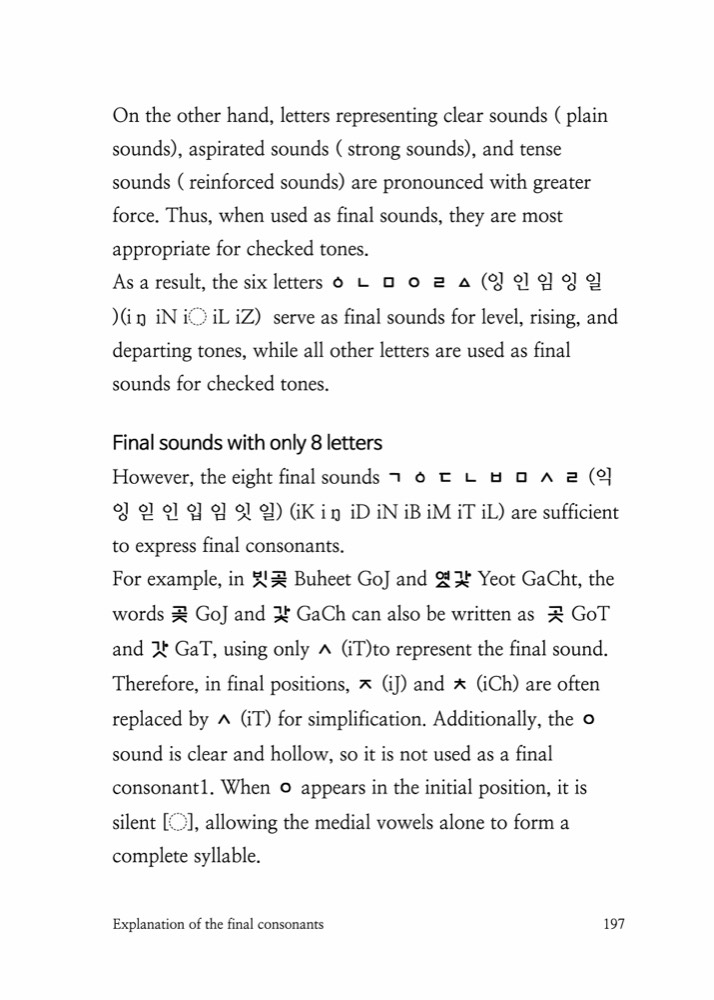
For example, in 곶 Buheet GoJ and 갗 Yeot GaCht, the
words 곶 GoJ and 갗 GaCh can also be written as 곳 GoT
and 갓 GaT, using only ㅅ (iT)to represent the final sound.
Therefore, in final positions, ㅈ (iJ) and ㅊ (iCh) are often
replaced by ㅅ (iT) for simplification. Additionally, the ㅇ
sound is clear and hollow, so it is not used as a final
consonant1. When ㅇ appears in the initial position, it is
silent [◌], allowing the medial vowels alone to form a
complete syllable.
Explanation of the final consonants 197
여ᇫ
ᄇᆡᆺ