Explanation 5 · Three-Sound Harmony
HANGUL, The Cosmic Philosophy · p.205 / 428
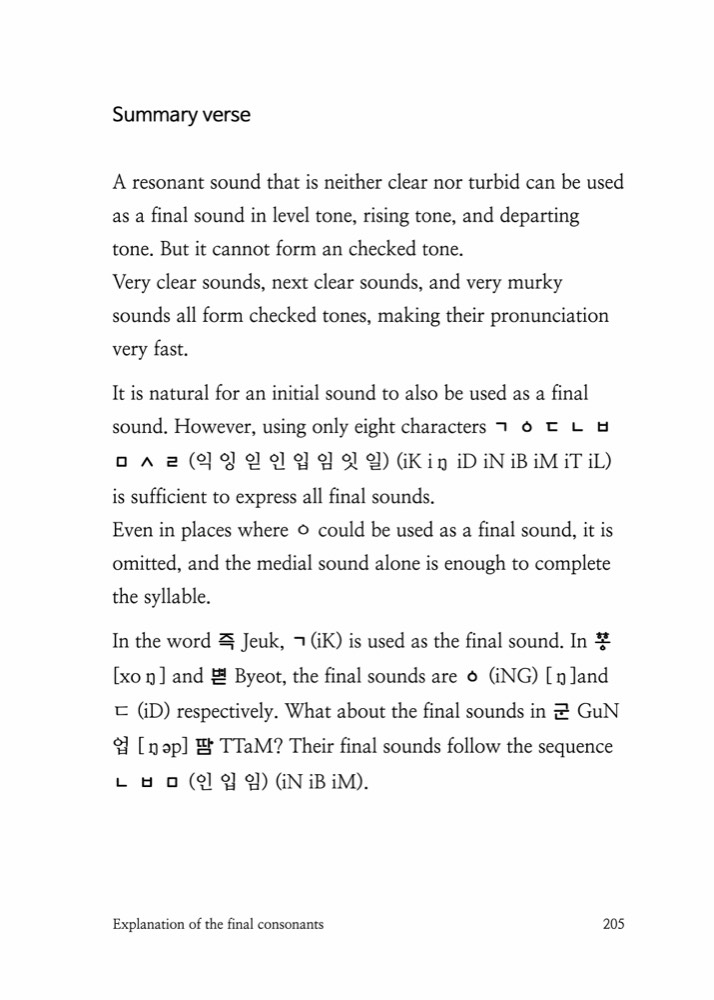
Summary verse
A resonant sound that is neither clear nor turbid can be used
as a final sound in level tone, rising tone, and departing
tone. But it cannot form an checked tone.
Very clear sounds, next clear sounds, and very murky
sounds all form checked tones, making their pronunciation
very fast.
It is natural for an initial sound to also be used as a final
sound. However, using only eight characters ㄱ ㆁ ㄷ ㄴ ㅂ
ㅁ ㅅ ㄹ (익 읻 인 입 임 잇 일) (iK iŋ iD iN iB iM iT iL)
is sufficient to express all final sounds.
Even in places where ㅇ could be used as a final sound, it is
omitted, and the medial sound alone is enough to complete
the syllable.
In the word 즉 Jeuk, ㄱ(iK) is used as the final sound. In
[xoŋ] and 볃 Byeot, the final sounds are ㆁ (iNG) [ŋ]and
ㄷ (iD) respectively. What about the final sounds in 군 GuN
[ŋəp] 땀 TTaM? Their final sounds follow the sequence
ㄴ ㅂ ㅁ (인 입 임) (iN iB iM).
Explanation of the final consonants 205
ᅘᅩᇰ

ᅌᅥᆸ