Appendix · Additional Notes
HANGUL, The Cosmic Philosophy · p.301 / 428
Just as the number 0 revolutionized mathematical thinking,
    the consonant ㅇ offers a revolutionary framework for the
    structure of writing. These two symbols, which reinterpret
    “emptiness” in new ways, contain within their circular forms
    —the shape of the sky—the seeds of human thought and
    civilization.
    At the time of Jeongeum’s creation, the cosmological
    worldview of Heaven, Hanul-Above, Earth, Ttang-Below,
    Life, Saram-in-Between (Hattangsa) was prevalent. This
    worldview was often symbolized by “one, two, three” (1, 2,
    3). In today’s world, where the concept of 0 is widely
    accepted, the foundational principles of Hangul—represented
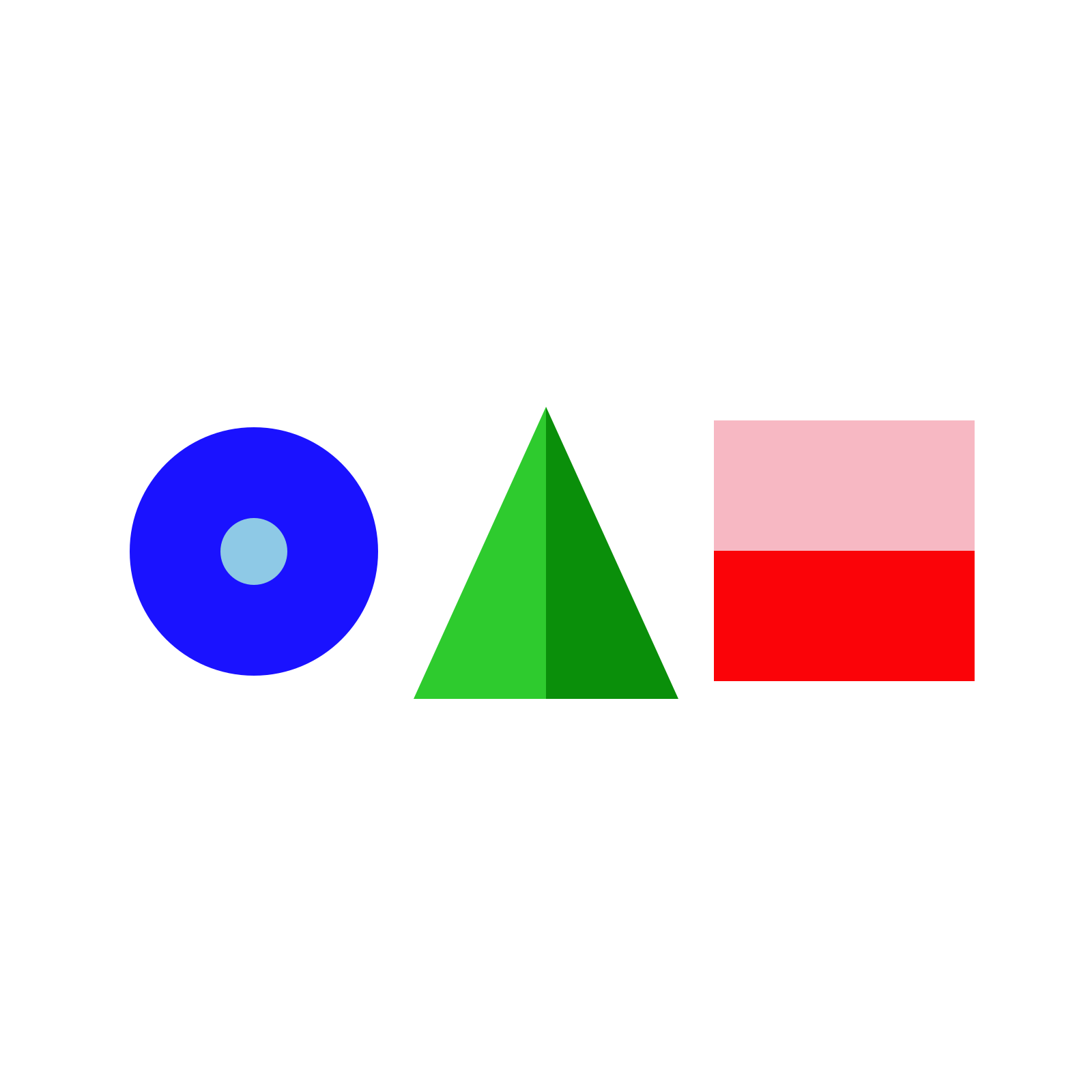
    by ㅇㅅㅁ and ㆍㅣㅡ—can correspond to 0, 1, and 2,
    respectively.
    This shows that the Korean philosophy of Hasattang and
    Wonsene is deeply connected with the universal principles of
    numbers. The sequences and philosophical frameworks of ㅇ
    ㅅㅁ, ㆍㅣㅡ, and 0 1 2 go beyond superficial similarities in
    form; they embody the order of the universe. Their
    alignment suggests a universally shared structure of meaning.
    As with the number 0, a deeper exploration into the meaning
    of ㅇ is needed.


    Appendix - Additional explanation                            301